ODEJDI OKNEM, DVEŘE NECH OTEVŘENÉ
HIDDEN at (A)Void Gallery
Náplavka, Rašín Embankment, Prague 2
12. / 25. 8. 2026
Guided Tour 19. 8. 19:00
As the seventh exhibition of HIDDEN’s summer programme at (A)VOID Gallery, Cambion presents a solo exhibition by Renata Jelínková, exploring collective memory, the transience of time, and the quiet poetry of abandoned places suspended between reality and imagination.
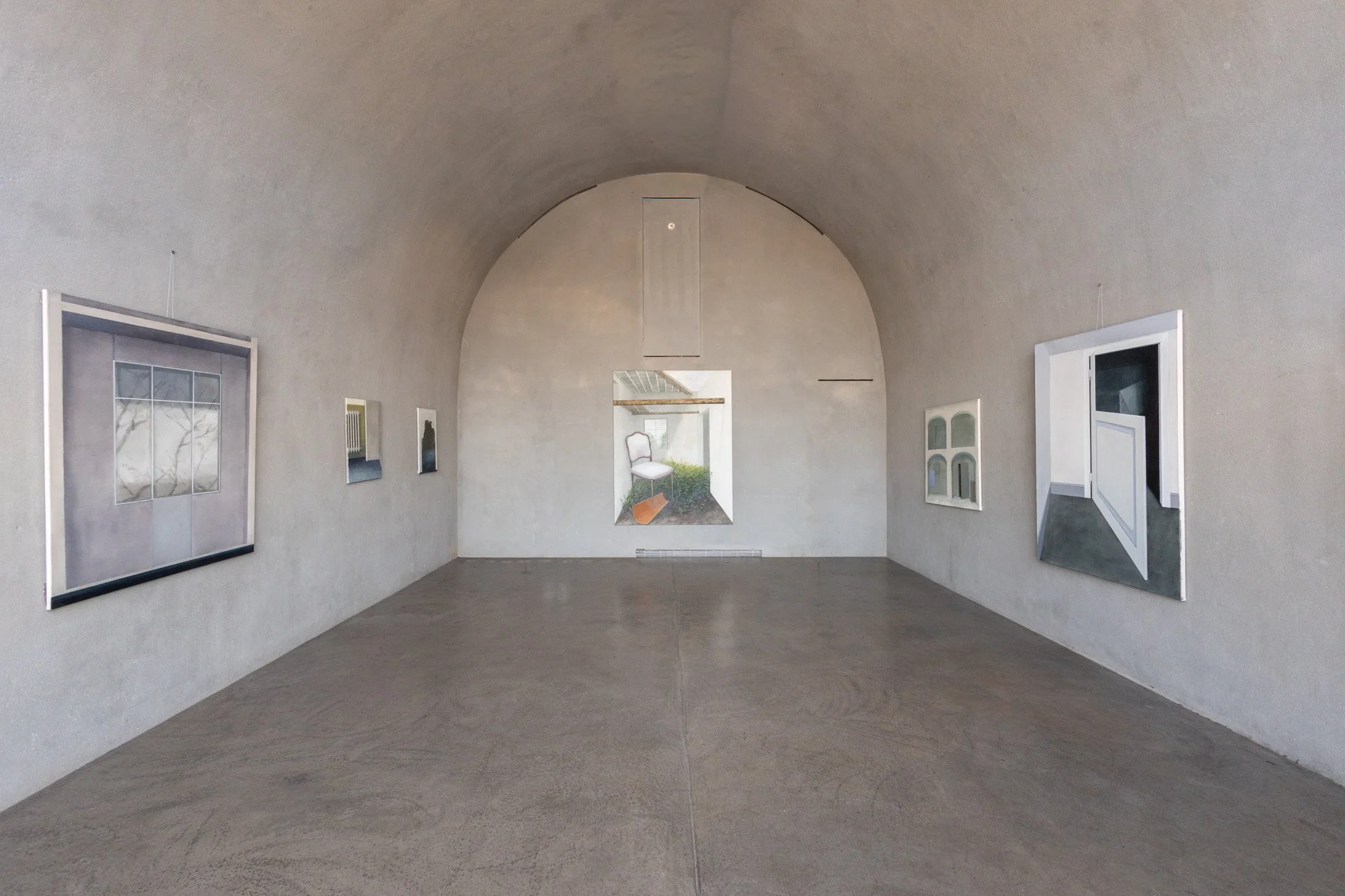
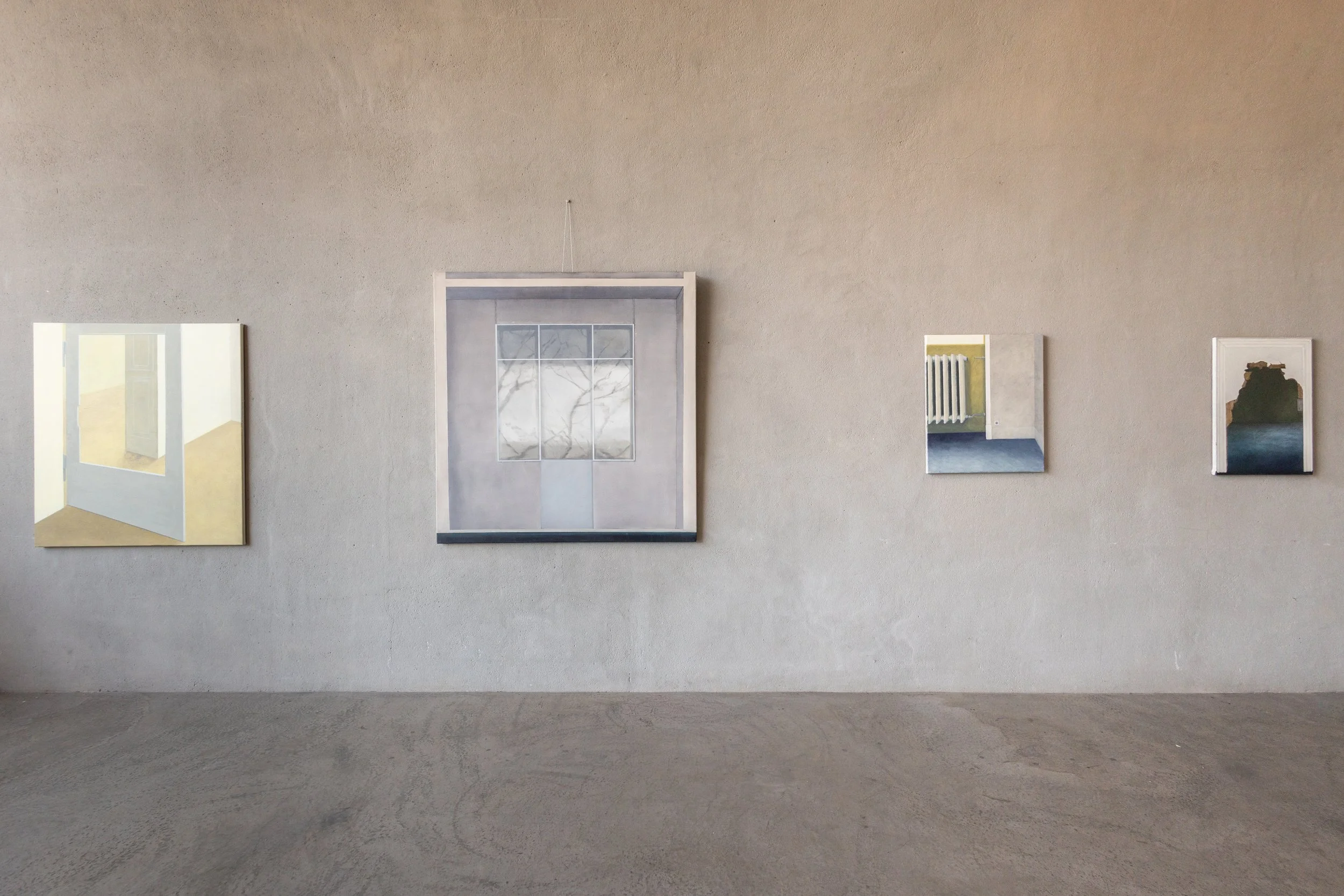
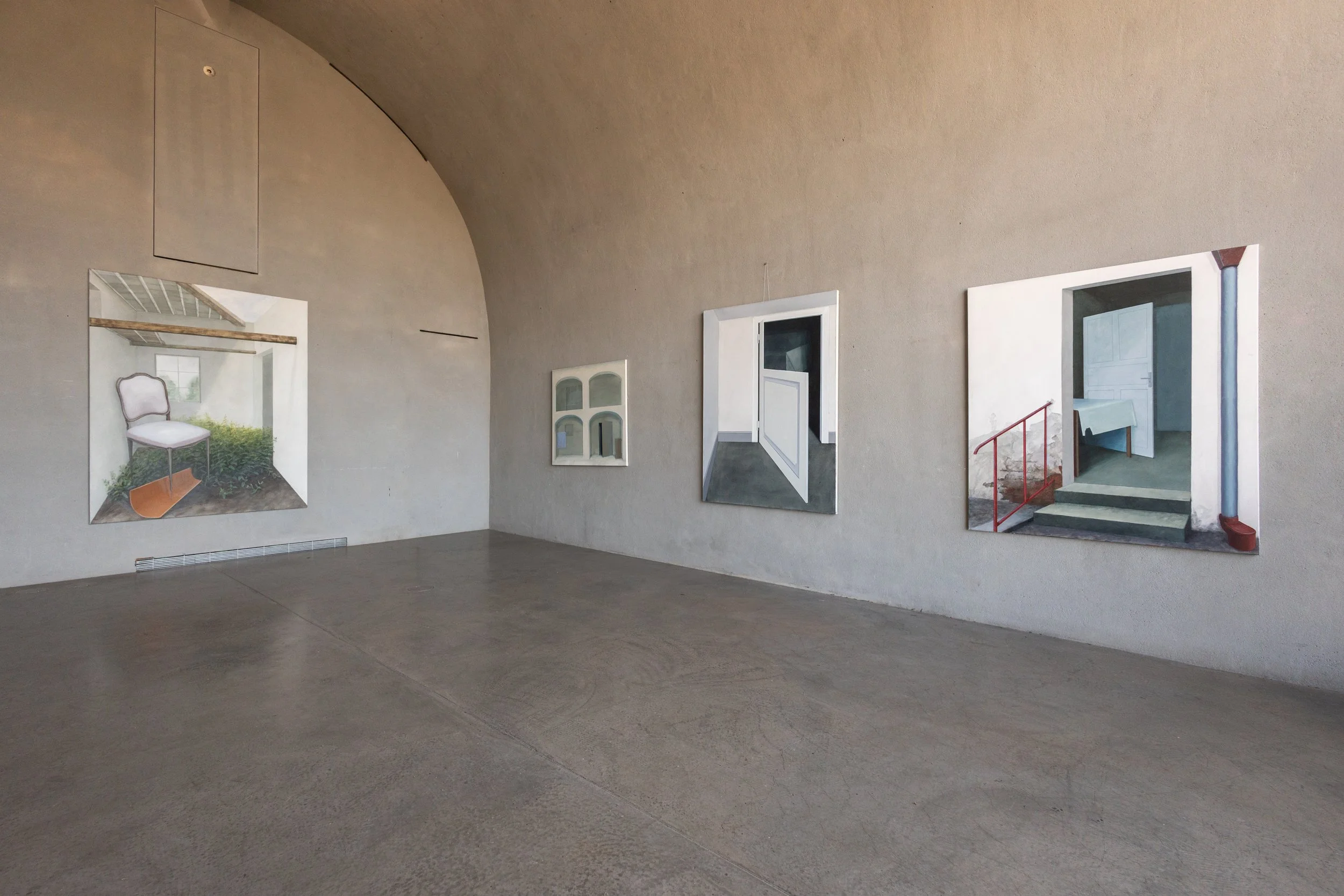
The artist finds inspiration in abandoned places, where the erosive force of time becomes a metaphor for the transience of memory. Her paintings are delicate and fragile, yet they evoke an unmistakable sense of unease. Jelínková draws us into liminal spaces that create the illusion of being lost somewhere between worlds. The pervasive silence and solitude suggest that something is fundamentally out of place. She reflects on the notion of terrain vague, abandoned, neglected, or temporarily unused spaces that exist outside conventional definitions of the urban environment. Her compositions depict functionally ambiguous, constantly shifting, and difficult to classify landscapes that resist the traditional categories of urbanism. The harder we try to maintain control, the more we lose ourselves. Jelínková captures the lyricism of places that exist beyond the center of attention.
The painter strips away unnecessary visual elements in favor of overall atmosphere and chromatic relationships. She seeks out unusual combinations and absurd details within seemingly ordinary settings. As a result, her paintings invite layered and ambiguous interpretations, leaving the viewer uncertain where observed reality ends and the artist’s imagination begins. She describes her aesthetic strategy as civil archaeology. The concept recalls Walter Benjamin’s figure of the ragpicker, who collects everything forgotten, discarded, and overlooked. Likewise, Jelínková uncovers hidden value in neglected things, assembling them into new ways of seeing the world. She investigates the traces of time, its tectonics, sedimentation, layering, and overlapping, bringing together objects and architectural elements from different historical periods within a single image.
We are confronted with fragmentary glimpses of places marked by the subtle yet unmistakable touch of history. The artist approaches motifs of decay and neglect with remarkable sensitivity. In his essay The Ruin, Georg Simmel understood the ruin as a dynamic relationship between human order and the entropic force of nature. Jelínková replaces nature with the very principle of time, which reshapes human creation into a new aesthetic form. The ruin is not merely a remnant of the past but a crossroads where humanity’s desire for form encounters the inevitability of its eventual disintegration. Yet decay is not a failure of reality. It is its very condition. Reality is not a harmonious, logically ordered whole but a constellation of contrasts and imbalances that appear irreconcilable while together constituting its essence. In Jelínková’s work, reality is never purely factual. It is permeated by imagination, memory, and a quiet sense of anxiety. Her abandoned landscapes, suspended between tension and an uncanny calm, bear silent witness to the distortion of lived experience.
The artist combines unsettling experience with meditative solitude, a state in which one longs to remain undisturbed. This paradox resonates with Ivan Vyskočil’s concept of “public solitude,” developed in the context of dialogical acting at the intersection of psychology, therapy, and theatre. It describes the condition in which an actor, though standing before an audience, is completely immersed within themselves, capable of ignoring the spectators’ presence. In Jelínková’s paintings, the subject becomes permeable. What lies outside, the world, other people, reality, flows inward into thoughts, emotions, and consciousness, and vice versa. The self is no longer an autonomous, closed entity but the product of forces that continually pass through it. Some may perceive this as a tragedy. Others may see it as a Zen like reconciliation with the chaos of existence. Jelínková belongs to the latter
— Kamil Princ
Renata Jelínková (b. 2001) is currently completing her final year at the Academy of Fine Arts in Prague, where she studies in the Drawing Studio under Alice Nikitinová and Matěj Smetana. During her studies, she also attended Professor Thomas Eggerer’s studio at the Academy of Fine Arts Munich. Previously, she studied at the Faculty of Arts of the University of Ostrava in the Painting II Studio led by František Kowolowski and Jiří Kuděla. Her painting practice explores themes of collective memory, the mutability of recollection, and the distortion of lived experience. Time occupies a central place in her work, its recording, visual expression, and the awareness of its inevitable transience.
Untitled
Acrylic and oil on canvas
150 × 195 cm
2025
Unavailable
Za sklem
Acrylic and oil on canvas
130 × 135 cm
2026
Unavailable