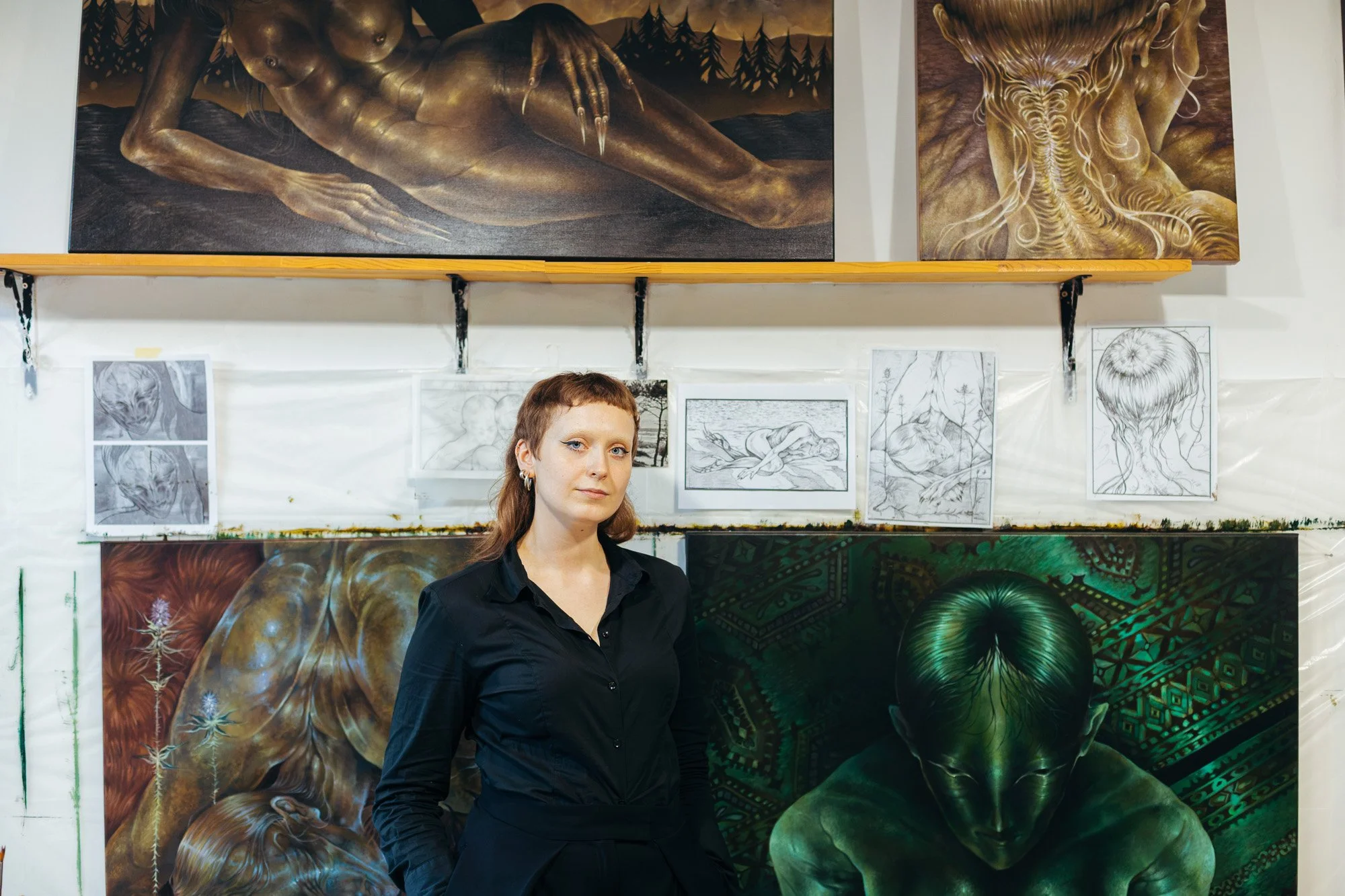
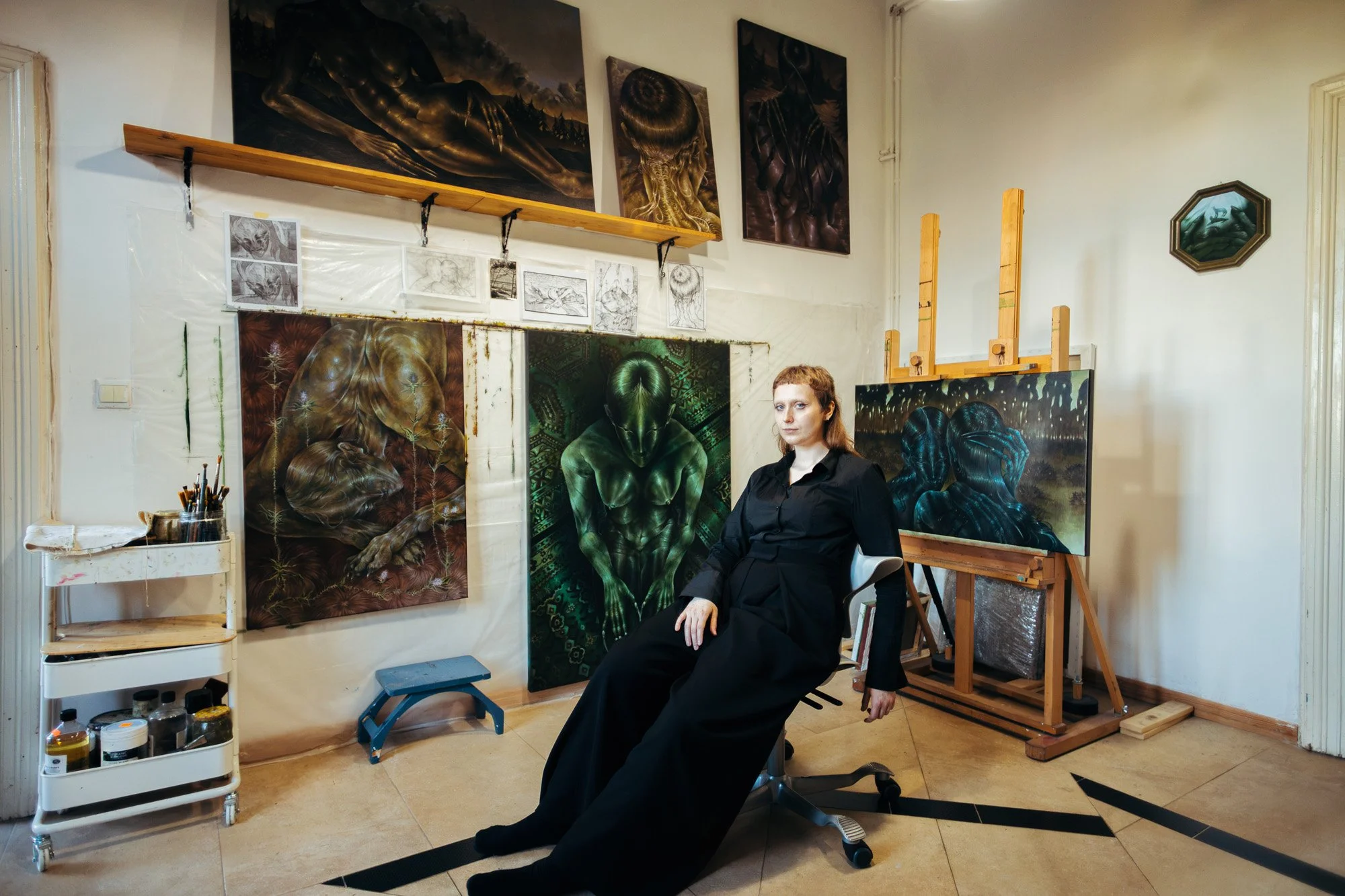
HIDDEN Gallery continues its Artist in Focus editorial series with Natalia Kleszczewska, a Polish painter whose work explores imagined futures, cultural memory, and the uneasy space between the familiar and the alien. Drawing on Mark Fisher’s idea of lost futures, as well as the visual languages of neo-noir, synth-pop, horror, and romanticism.
Following her recent collaboration with Björk and Natalie Liu on Nerve Bloom, presented at the National Gallery of Iceland, this conversation explores the ideas behind Kleszczewska’s practice, her approach to painting and digital media, and the new body of work she presented at HIDDEN.
ON THE LOST FUTURE
You have spoken in context with your work about Mark Fisher and his idea of the “lost future”, the feeling that contemporary culture keeps returning to the aesthetics of futures that never actually arrived. Is this one of the reasons your paintings often look simultaneously futuristic and strangely nostalgic?
I think this perspective really captures the effect I care about most. I have long been fascinated by Fisher’s writings and by the music, films, and other media he wrote about extensively. This connection struck me as an interesting and fresh way of looking at my own interests and sources of inspiration. The term “Lost Futures” feels particularly fitting. I try to combine what feels foreign with something familiar, or to use things we already know as a basis for creating a glimpse of the future.
Two of the main elements that shape my ideas are flirtation and dread. I’m drawn to the charm of something that can be monstrous or alien, like a favorite new wave song or a neo-noir film. I want to create a world that exists somewhere between attraction and repulsion and, in a way, embodies its own form of vampirism.
Fisher argues that we have become very good at imagining different versions of the present, but increasingly unable to imagine a genuinely different future. Do you think your creatures inhabit such a future, or are they already ghosts of futures we have lost?
I believe both interpretations are valid. I see these figures as personifications or symbols that carry meanings beyond their individual identities. Their identities are quite fluid, shifting from one painting to the next. They are a continuation of themselves, but at the same time, they seem to be trapped in a kind of void. The spaces in my paintings may sometimes appear classical or empty, but that emptiness is actually what matters most to me. It creates a desolate world where these solitary figures wander. In a way, the space reflects the inner nature of the figures themselves, so the two exist in a kind of symbiosis.
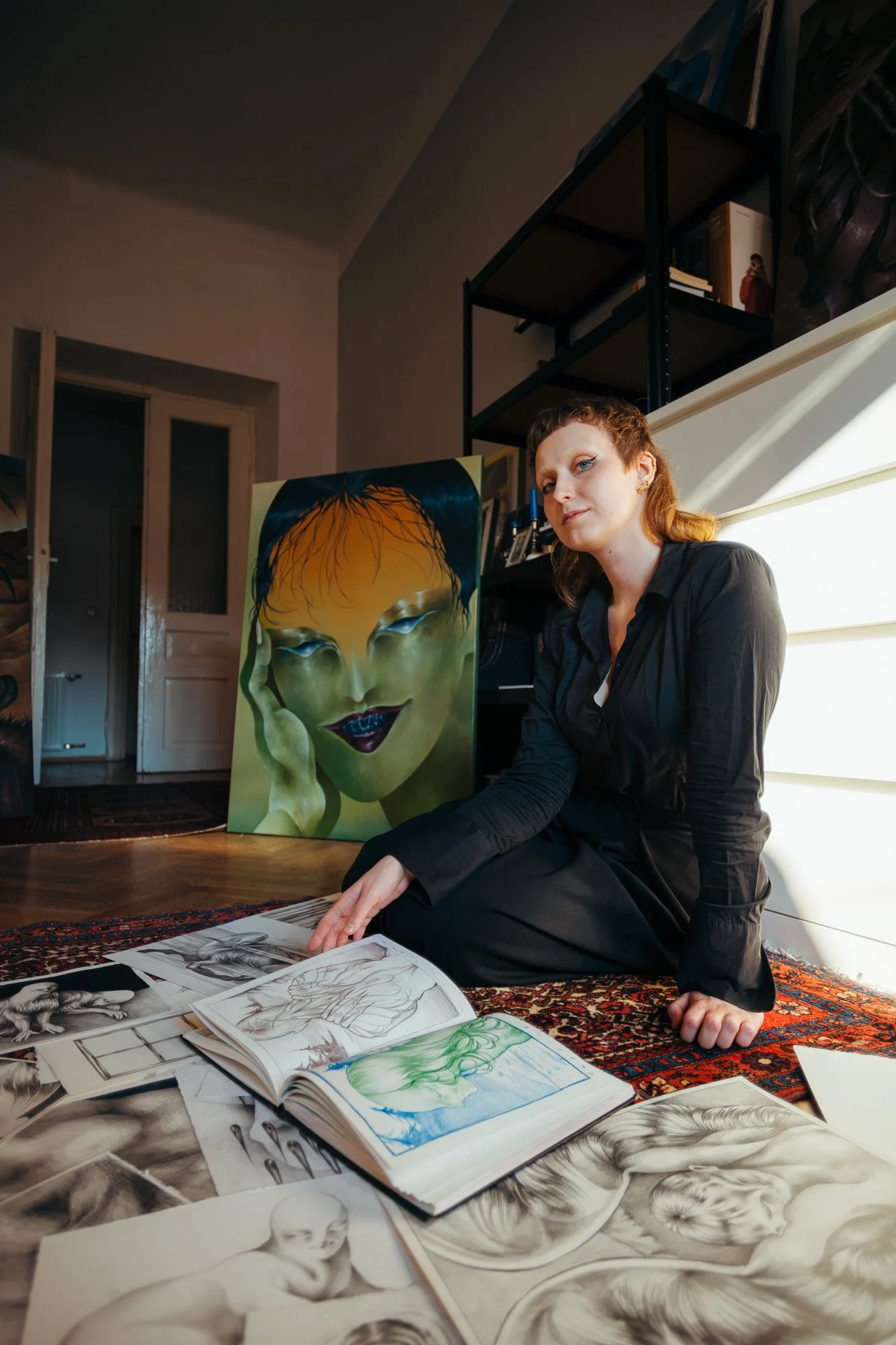
Natalia Kleszczewska comes from the Suwałki region in Poland. A graduate of the Academy of Fine Arts in Katowice, she received her degree with honors. An active painter, she also works across graphics and drawing.
Her interdisciplinary practice extends to international collaborations, including Nerve Bloom, a project developed with Björk and Natalie Liu, which was presented at the National Gallery of Iceland. Presented at numerous artistic events, her work includes participation in the 29th Polish Poster Biennale, LOOSTRO: Autumn Art Salon 2025, and the Utazu Art Award Biennale in Japan in 2020. She continues to create actively and collaborates with galleries and artists both in Poland and internationally.
In her works, there is a certain foreshadowing of a future that never came to pass, becoming a specter or a myth trapped in the past and in memories. The artist treats these motifs as an attempt to create a new, artificial romanticism, detached from the familiar, and consequently presents it as a phenomenon from another planet.
ON CREATURES
The painting Black Beauty (150 × 120 cm, 2024) seems to mark an important starting point for this world. The creature is recognisably a horse, yet something about it feels deeply unfamiliar. If you encountered this creature alone in a forest, rather than in a painting, would you be afraid of it?
Black Beauty was one of the first paintings where I started bringing together many of the themes I’m interested in and developing the fictional worlds I had been imagining for some time. The title is a nod to Anna Sewell’s Black Beauty, one of the earliest novels written from an animal’s perspective. At the same time, the painting is also a kind of love letter to Leonora Carrington and the imaginative worlds she created.
If I were to encounter a similar creature in nature, I would, of course, probably feel fear. In my work, I’m interested in the unnatural, and I think fear and uncertainty are often our first reactions to something unfamiliar. At the same time, I feel a certain warmth and fondness towards this particular figure. Perhaps we could become friends…
You often refer to these figures as aliens, yet they seem to carry traces of something deeply human. Could they be imagined not as beings from another world, but as versions of ourselves from a distant future, shaped by an evolution we can no longer recognise?
I think this interpretation fits really well. To me, the term “alien” doesn’t simply mean an entity from outer space. I’m more interested in the idea of a mysterious, otherworldly being that is unknown to the viewer. At the same time, I don’t see these figures as completely separate from us. The forms I paint aren’t strictly “alien” or “human” either. For me, that distinction is much more fluid, and the two aren’t necessarily mutually exclusive. After all, couldn’t humans also be considered aliens from another perspective, since we’re living on our own little planet floating through space?
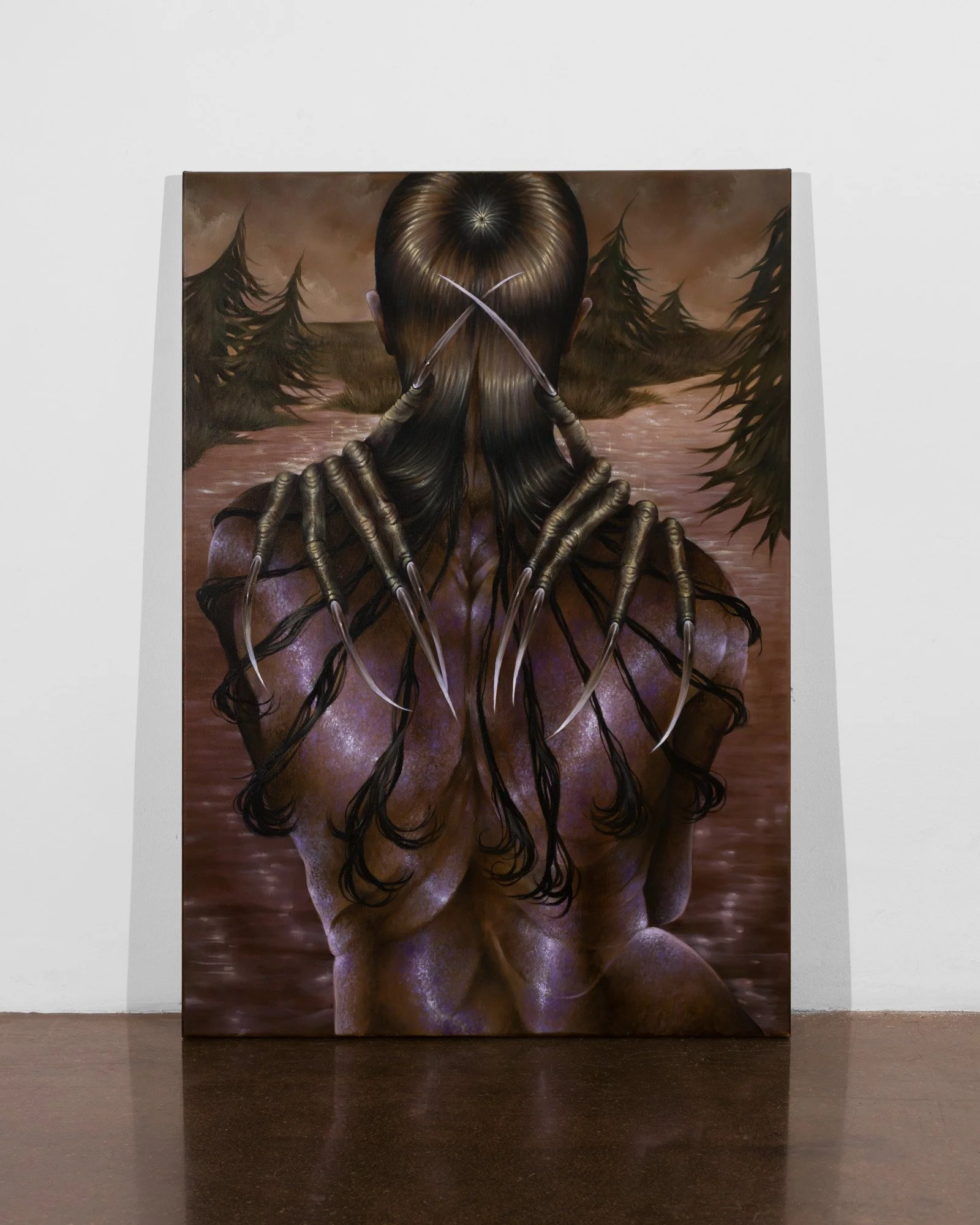
Marzanna (By the River)
Marzanna is a figure associated with Slavic traditions of winter and death. In Poland, her effigy is traditionally carried to the water and destroyed, drowned or burned, as part of a spring ritual marking the end of winter.
Kleszczewska approaches this familiar myth playfully. Her Marzanna does not drown. Instead, she enjoys swimming in the river. The figure survives the fate traditionally assigned to her and remains in the water, turning what should have been an act of destruction into something almost pleasurable.
For Kleszczewska, this is a way of creating a new perspective on an old story. Rather than simply reproducing the mythology, she plays with it, imagining an alternative storyline for a familiar figure. Marzanna, traditionally associated with death and winter, is therefore allowed to continue existing beyond the end that her ritual prescribes.
ON ROMANTICISM
You have described your work as a kind of “artificial romanticism”, where something familiar and nostalgic encounters something alien. What makes a romantic image feel artificial to you?
I love the performative quality of romanticism and the way these kinds of aesthetics, narratives, and emotions can continue to live on and mutate into something new today. I like to add the idea of artificiality because what interests me most is creating a new form of romanticism that belongs to our own timeline while also reaching beyond it. We live in an increasingly artificial world, where the boundaries between the real, the imagined, the cybernetic, and the constructed are becoming more and more fluid. I’m interested in this kind of binary tension: the old and the new, romanticism and artificiality, the organic and the constructed. For me, bringing these seemingly opposing elements together is what allows romanticism to take on a new form.
Can something genuinely new still feel romantic, or does our idea of romance inevitably come from things we have already seen and remembered?
I think I’m working with things we’ve already seen and can recognize, but looking at them through a different lens, specifically, an alien one. The way of seeing is different, but the way we express what we feel isn’t. I treat these experiences as something quite universal, but explore them through the perspectives of strangeness and otherness.
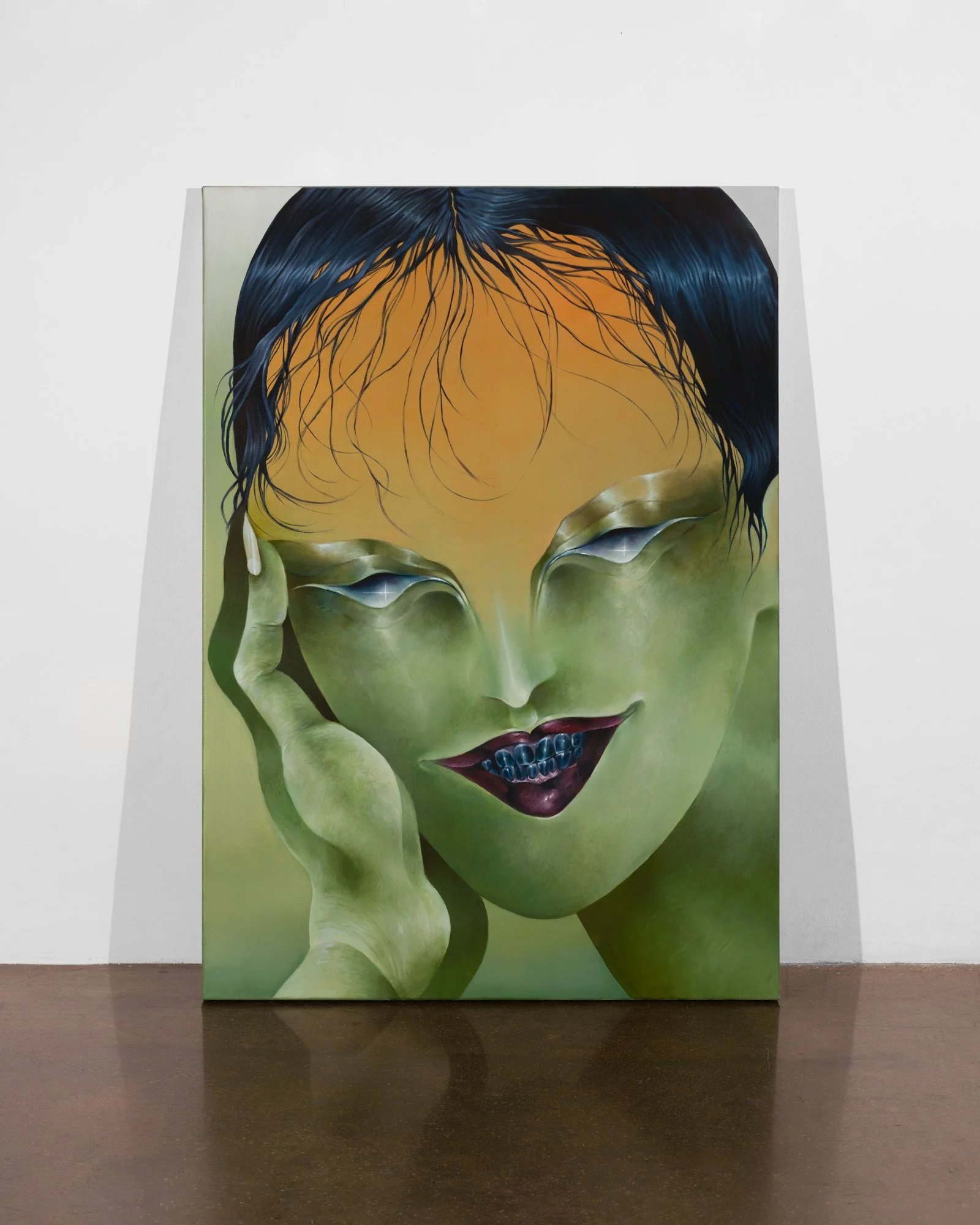
Ghost Girl I
The painting takes inspiration from Ohaguro, an old Japanese tradition of blackening the teeth, historically associated with beauty, status and adulthood. Seen from a contemporary Western perspective, however, blackened teeth can appear unsettling or even monstrous.
Kleszczewska transforms this contrast into a playful portrait of a ghost girl wearing blackened teeth and bright red lipstick. Rather than appearing frightening, the figure seems to enjoy her appearance and feel beautiful in her own way.
Through this character, Kleszczewska explores how cultural symbols change meaning across time and contexts. She approaches Ohaguro through the lens of womanhood, using an unfamiliar tradition to create a new image of beauty that sits somewhere between the attractive and the unsettling.
ON BJÖRK / NERVE BLOOM
Your collaboration with Björk on Nerve Bloom brought your painted world into a completely different medium. You painted the creatures and environments, Natalie Liu developed their digital dimension, and Björk shaped the work through music, colour, texture and dramaturgy. What was it like to see something that began as a physical painting become part of a moving, digital and sonic world?
It was a really surprising and inspiring experience. I’m not used to seeing my paintings literally come to life on screen, so watching them take on a new form was really fascinating. For the past seven months, the three of us have been developing this creative project, blending together music, animation, and oil painting to create a world where analog craftsmanship and digital technologies converge. However, I’ve always worked a little with digital media and music, so this collaboration felt very natural from the start and involved the media I love the most. This is a special project for me, and in a way, a dream come true. Music has always been one of my main sources of inspiration, especially for painting, so being able to bring these two things together feels really meaningful to me. I’m really grateful to have been part of this project and to experience this magical process together.
Your process for Nerve Bloom was very different from making a painting that exists entirely on its own. You first painted the backgrounds, which were photographed and then used as a basis for the next stage, before creating the creatures and layers that would later be animated. How did knowing that your paintings would be taken apart, layered and transformed change the way you approached painting, and did anything from this process remain in your practice afterwards?
It's quite interesting because, surprisingly, the experience didn't feel very different for me. I majored in graphic arts with a specialization in digital media, so layering different elements in a painting feels very natural to me, much like working with layers in Photoshop. Of course, there were some differences, especially since this was the longest series I've ever created. I've always tried to bring graphic qualities into my paintings and painterly qualities into my graphic work. I've often been told that my paintings have a very strong graphic character, and I take that as a compliment.
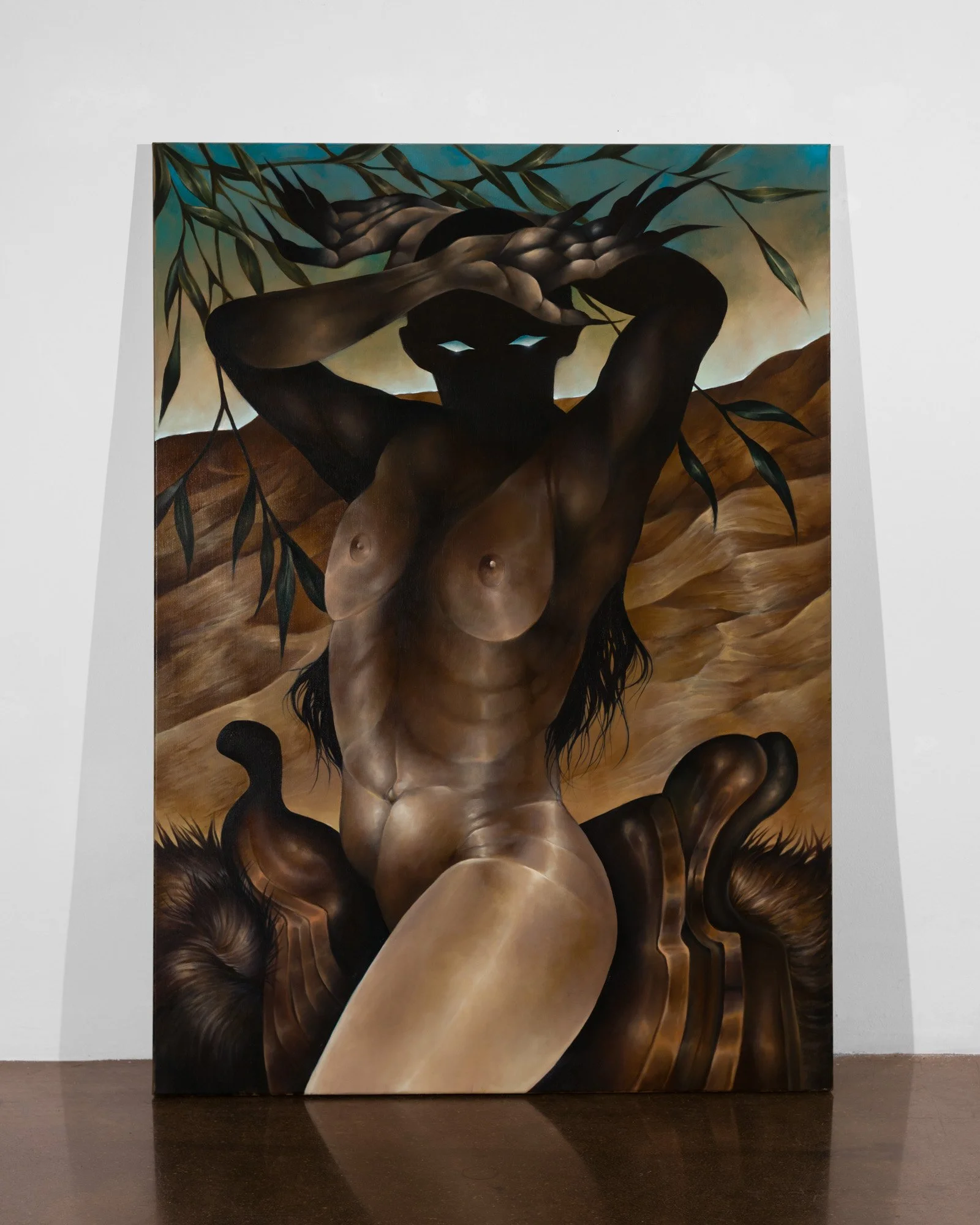
Rider (in the desert)
In Rider (in the desert), Kleszczewska presents one of her most distinctly human female figures. The body is unusually anatomical and recognisably human, while the face remains almost completely obscured, with only two luminous eyes visible through the darkness. The desert winds seem to reinforce this sense of concealment, while the glossy surface of the body leaves its material deliberately ambiguous. It could be slimy and organic, almost unsettling, or metallic, like armour.
The woman is not alone in this landscape. She rides an unfamiliar creature that cannot quite be identified as any existing animal, suggesting another inhabitant of Kleszczewska’s increasingly imagined world. The artist has spoken about moving towards world building, creating environments and rules for the creatures that inhabit them. Rider (in the desert) feels like one fragment of that world, leaving open the possibility that the mysterious creature beneath her may eventually appear in another form, with its own story and place within it.
ON THE NEW WORK
You are now taking your work into a new exhibition at HIDDEN in Prague. After working with CGI, animation and music, what are you looking for in painting now?
I’m interested in seeing how far I can take my painting while allowing other media to become part of the process. As I mentioned earlier, both digital techniques and music have been integral parts of my work for a long time. I see expanding my practice beyond the canvas as a natural progression of what I’ve already been doing. I have several new exhibitions coming up, and I’m always looking for new ways to experiment. I’m continually developing a vocabulary of spectral forms and expanding my series of works to include intermedia and set designs.
If Fisher was right that we are haunted by futures that never arrived, what kind of future would you like your paintings to make possible?
I certainly don’t want to remain trapped by the curse of being unable to generate new ideas. Instead, I take a somewhat tongue-in-cheek approach, weaving together alternative futures from archetypal elements, forgotten stories, and myths. Although I recognize that I’m creating a kind of aesthetic-symbolic remix, I’m often surprised by what emerges as I create. I’d like my paintings to create a small window into futures that we haven’t learned how to imagine yet.