UNCANNY PARADISE
HIDDEN at (A)Void Gallery
Náplavka, Rašín Embankment, Prague 2
10. 7. / 23. 7. 2026
Guided Tour: 17. 7. 2026, 19:00
As the fifth exhibition of HIDDEN’s summer programme at (A)VOID Gallery, Uncanny Paradise presents a two-person exhibition by Eva Fajčíková and Klára Hartlová. Through painting and psychology, the artists construct an unsettling landscape where paradise gives way to decay, memory dissolves into forgetting, and the familiar becomes uncanny.
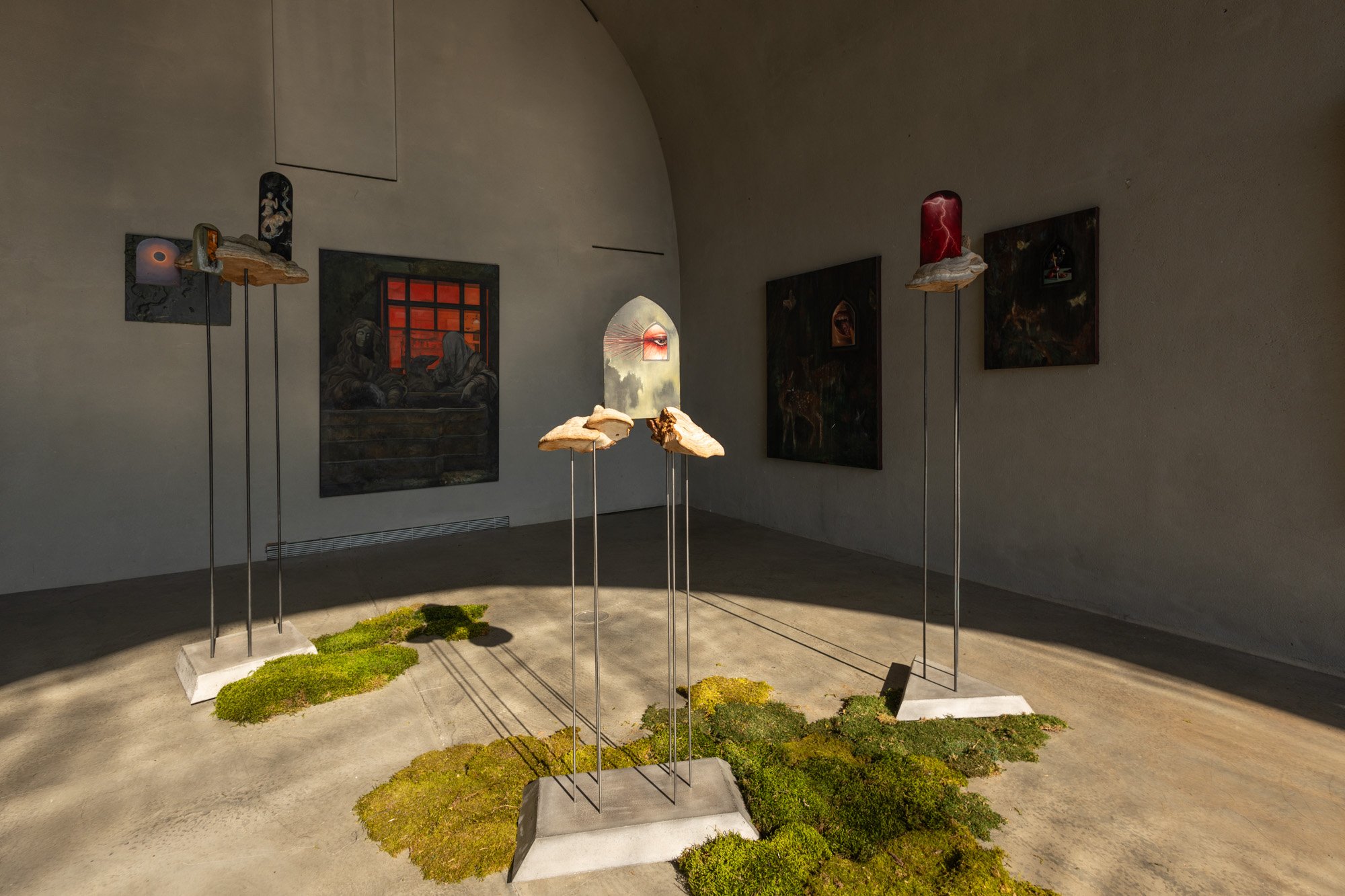
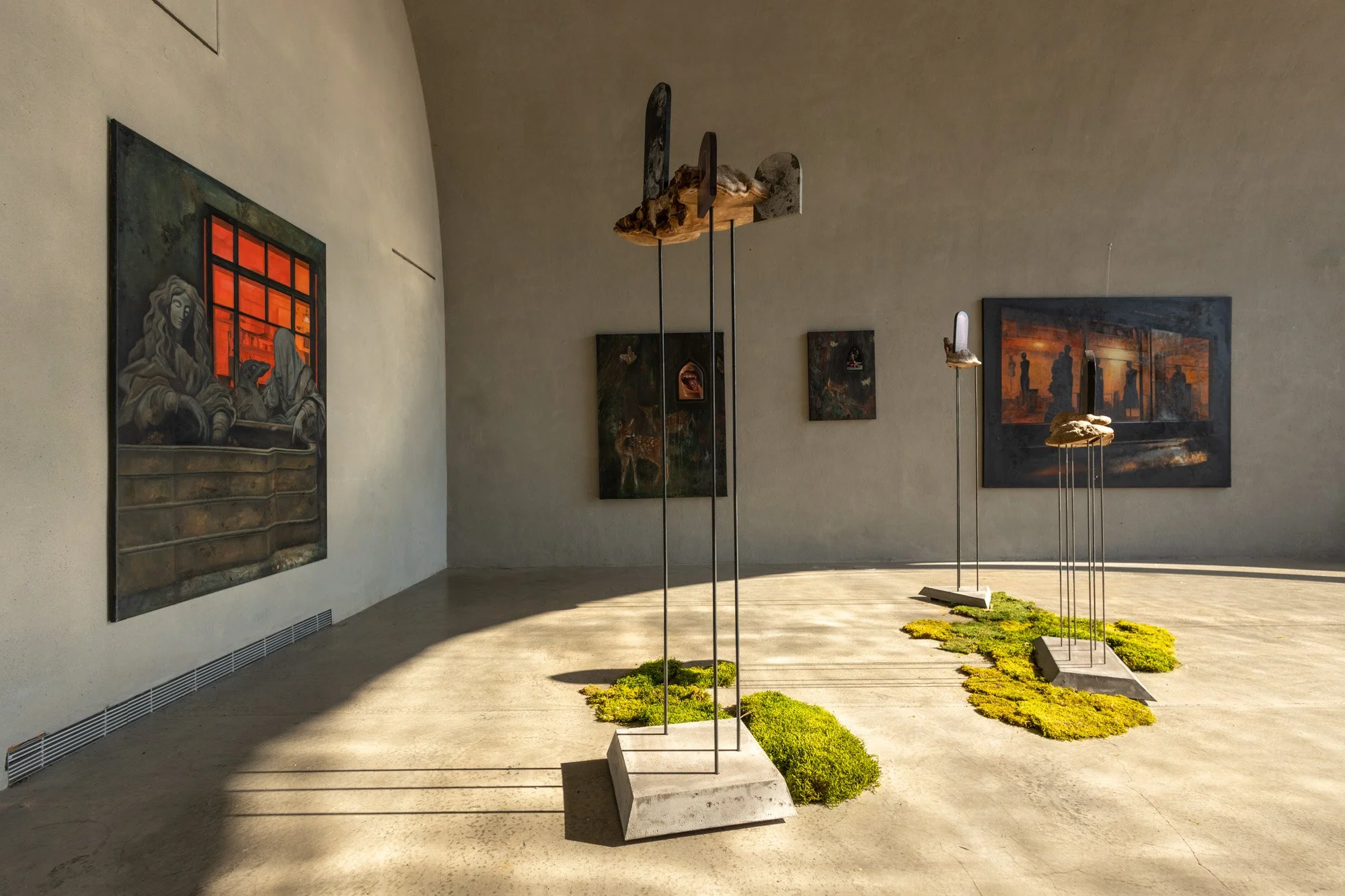
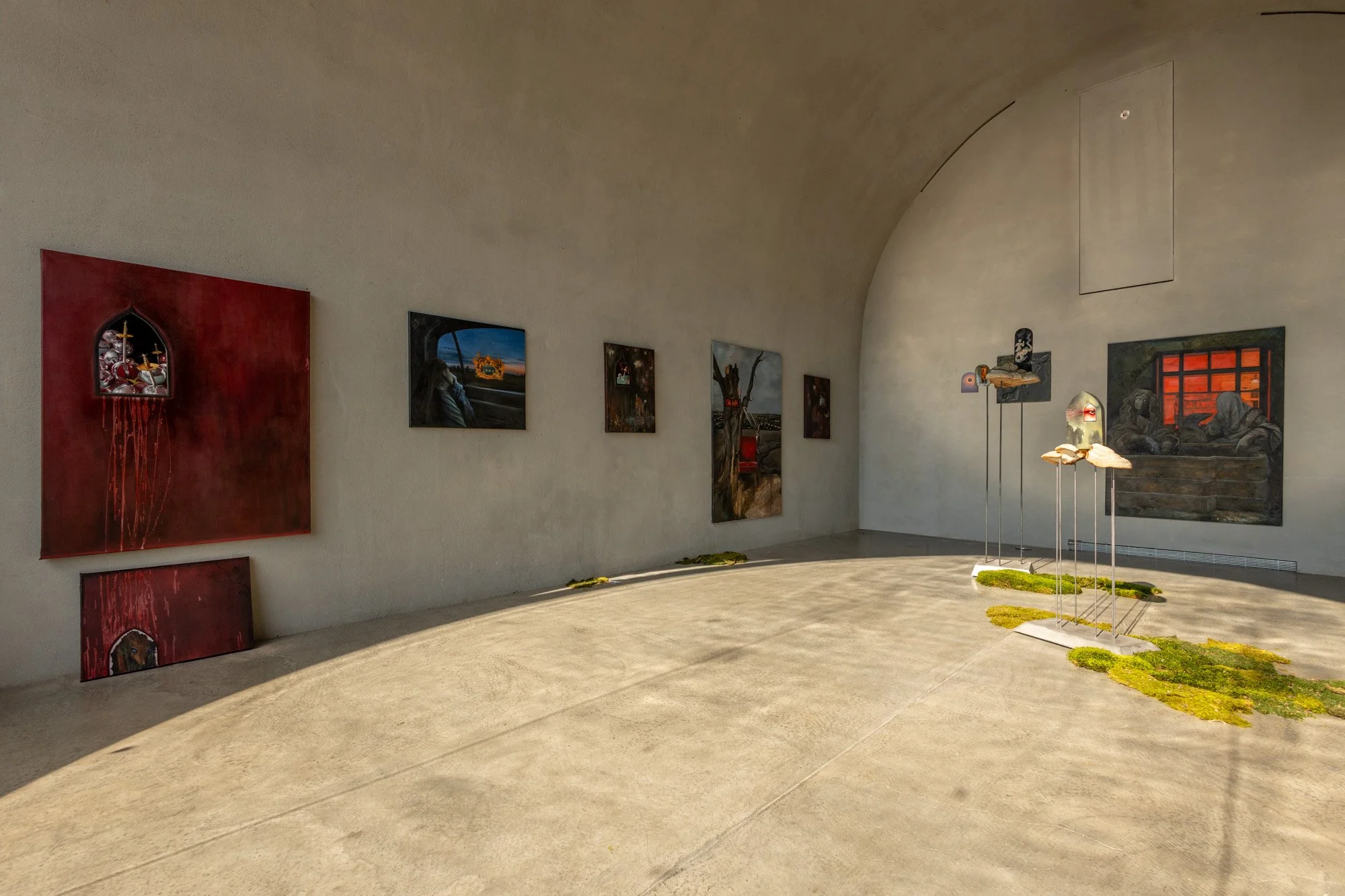
Uncanny Paradise by Eva Fajčíková and Klára Hartlová opens up panoptical spaces where, beyond the gates of Eden, shattered ruins and omnipresent decay await instead of the promised bliss. Within this realm of paradoxes, human identity endlessly fractures and reforms in a vast kaleidoscope of solitude. We find ourselves in an Alice-like world beyond the broken looking glass, where illusion has eclipsed the sun and nothing is as it seems.
The artists expose the deceptive Garden of Paradise as a constructed psychological and mythological space—one we long for, yet which, upon closer inspection, reveals only instability and elusiveness. Nothing is permanent; everything moves toward its own dissolution. Here, decay is not an accident but an existential imperative. The ruin makes transience visible while simultaneously embodying a memento mori. These are not the fantastical ruins of G. B. Piranesi, but the haunting, solitary remnants found in the forgotten landscapes of C. D. Friedrich. This mystical terrain, suspended between life and the afterlife—where thought replaces time and space melts like wax—transforms Dalí’s concept of the persistence of memory into the persistence of forgetting.
Although the forest ought to be a place of solace, it has become inexplicably dangerous. It is a mysterious liminal zone between civilization and wilderness, where one no longer exists and the other has yet to emerge. We are overcome by the landscape itself—its relentlessness and desolation. Its immense, lonely, perhaps even hostile expanse fills us with dread. Here, Fajčíková and Hartlová stage the tragedy of Timothy Morton’s dark ecology, which rejects the traditional notion of nature as pure, harmonious, and untouched. Nature is instead invasive, unreadable, and profoundly unsettling—an inhospitable entropic force that engulfs us in its treacherous viscosity like the marsh from Antonín Sova’s verses:
“Only the ancient marsh stretches all around… / Corrupted air, low pines and reeds, / and people crawl, every moment wasted, / desires grow small and all purpose is lost…”
Paradise, however, need not be merely a necropolis from whose gravestones we assemble the mosaic of a long-dead history. It can also be understood as a hyperobject—something elusive, impossible to localize, dispersed across time and space, yet uncomfortably close and permanently present. The boundary between the human being and the environment collapses; each seeps into and contaminates the other. Windows and thresholds become passages between different states of existence, leaving us uncertain whether we are awake or hallucinating. We witness the disillusionment of a lost paradise that has unexpectedly transformed into Dante’s Inferno.
Charles Baudelaire’s concept of correspondences—the hidden relationships between the senses, the world, and the soul—offers a faint ray of light capable of partially illuminating the black nebula of this paranormal environment: “Imagination is the most scientific of faculties because it alone understands universal analogy, or what mystical religion calls correspondences.” The exhibition can therefore be read as a Symbolist network of analogies and hidden affinities. Closely linked to Baudelaire’s aesthetics are the so-called artificial paradises—altered states of consciousness induced by psychotropic substances. Today, one might equally regard antidepressants and nootropics as legal paradis artificiels. (Hartlová is a certified psychologist and psychoanalyst.)
In Fajčíková and Hartlová’s interpretation, paradise cannot be understood as a concrete place but rather as the perpetually unattainable object of desire—Lacan’s objet petit a. According to Jacques Lacan, we never truly desire the object itself, but something forever beyond it. Paradise may also stand as a monument to lost tomorrows, haunted by the ghosts of futures that never came to pass. All that remains is a paralysed, endlessly prolonged present—monotonous, empty, stagnant, and yet strangely nostalgic, like the lingering memory of a fleeting déjà vu.
Tempted by the apple of evil, the exhibition visitor gradually ceases to be a detached observer and becomes a participant in the wandering. We long to uncover the secret of this corrupted Eden, where Lucifer and Lilith have taken the place of Adam and Eve, and where carnivorous flowers bloom instead of lilies. Yet no answers arrive, and only a shadow remains:
“Everything moves straight ahead / and casts no shadow, / so the human disappears— / the shadow of a shadow, a shadow within a dream, / the dream of a shadow…”
— Kamil Princ
Klára Hartlová
Eva Fajčíková
End of Innocence
130 × 100 cm
2026
In the Hall of the Mountain King I
70 × 52 cm
2026
Infiltration
45 × 61 cm
2026
Unseen Future
130 × 100 cm
2026
In the Hall of the Mountain King II
70 × 52 cm
2026
Here Be Dragons
30 × 23 cm
2026